
Here are a bunch of my answers to running questions on Quora:
What should I know before I start running?
You should know there is a learning curve. Be patient with yourself the first weeks, month, year. You’ll need to figure out socks, shoes, seasonal clothes, water fountains and bathrooms where you run, and when/what to eat before running, etc. If you want to use a GPS watch you’ll need to research & experiment with that. You’ll get lots of advice and need to weigh & sort all of it (including this).
If you’re just starting it’s very likely your muscles & tendons will need quite a bit of adapting over time (e.g., early on I found out I was significantly “right-legged”). You may get early injuries (runner’s knee, IT band stuff, etc.) and may need PT and such (don’t give up if you do! such things are super common and can be addressed).
Your body is probably like a bicycle that hasn’t really been ridden much for a long time, and now is going to be used regularly for long miles. At the beginning it more or less all works but just about everything needs adjusting and fixing. Some things are obvious, others are more subtle, and some problems may not develop until after many miles. That’s all to be expected—just deal with problems one by one.
You’ll need to find your own schedule and style. (E.g., I don’t run with music but most folks out there seem to.) It’s a lot of time, so know what you’re going to change to make that time.
Find a local race maybe 3 – 4 months out and sign up (e.g., 5K/10K/Half). Find a training plan online (e.g., www.marathonrookie.com) and get to work. Maybe join a local running club. Find a good track nearby (high school, college) and use it.
How do I go from “Couch Potato” to running a half Marathon?
Pick an appealing race and register for it
Tell all your friends you are going to do it
Maybe recruit others to train & race with you
Pick a training plan you will actually do (tons online)
Count the real cost in time and effort (where and when are you actually going to actually do your training runs w/o fail?)
Maybe go watch or volunteer at a nearby race to pick up the vibe and get inspired. You will see runners of all shapes, sizes, and ages! If they can do it, you can do it.
Don’t give up! Injuries, shoe experimenting, bad run days, other setbacks are just part of the learning curve.
What is the best way to improve my marathon time?
There are lots of different ways—and they’re all hard work!
Probably the best way is to join a local running club and learn from more-experienced runners
Find a training plan and actually follow it (plenty online or in books—Jack Daniels, Hal Higdon, Hansons, etc.), absolutely including all the tough speed work. But note that while most recreational runners can hit weekly mileage targets, few (just on their own) can muster the drive to execute a full 16+ week plan with full intervals, tempo runs, pace runs, etc. Some coaching and/or group runs really helps here.
Teach yourself how to do full training runs even when you really don’t feel like it, the weather is bad, and/or there are other things you think you’d rather be doing
Of course get & use a good GPS watch and keep a scrupulously honest log of every run (including breaks during runs)
Do legit core & leg work (planks, bridges, crunches, hip hikes, lunges, etc.) 2x-3x/week
Experiment with different shoes and other gear to find what really works best for you (have to cull through tons of hype here)
Educate yourself about training & recovery, nutrition, race hydration, tapering, etc.
Run races and expect to be on a learning curve (e.g., learning how to control your pace the first several miles of a race is really, really hard)
Read lots + watch training videos on YouTube (Victoria Phillippi, VO2Max Productions, etc.) and pick out what is actually useful to you (plenty of bad / wrong / conflicting / irrelevant advice out there)
Don’t get injured; if/when you do, take it seriously (rest, professional physical therapy, etc.)
Set ambitious but realistic goals for your races and learn from each race
Don’t make excuses for yourself but be understanding (e.g., unexpectedly warm weather on race day = slower times for sure)
Practice & get good at gauging fuel & water intake during runs, timing/minimizing bathroom stops, layering clothes, etc.
Fully commit to a running lifestyle and the time / effort / $ that takes
The great thing about running is you actually do get the results you work for!
What is the average break in period when transitioning to zero drop running shoes?
Everyone is different, with different gaits, tendons & muscles, foot strikes, and preferences. Some can transition immediately and some may never adjust.
So I can only speak for myself: it took less than a week. In fact, I PRed in a race under two weeks after trying my first pair. (Yeah of course you’re not supposed to try new things so close to race day but sometimes it works out!).
Nowadays I easily switch back and forth tw traditionals and zeros.
All things being equal, zeros will always be lighter since there’s just less shoe there.
I could not say with any confidence how much of a difference the zero drop itself actually contributes (versus other features of a given shoe). I can say with confidence I’ve never been happier or run better in any other shoe.
If you took sharp turns while running a marathon do you end up running a little less than 26.2 miles?Nope, as long as you actually stay on the course.
A certified marathon is measured along the shortest possible route.
USA Track & Field – Procedures Manual
USA Track & Field – Certify Your Course
Is the running the ultimate full body work out?
Absolutely not. Running is basically doing a forward lunge over and over. It’s a great cardiovascular workout and great for certain muscles in your legs but does relatively little for the upper body or core. Runners have to supplement their running with other workout routines, including exercises for the lesser-used leg muscles.
If you want a more full-body workout you should try something like swimming or rowing.
I’d say running IS the ultimate high-volume, portable, enjoyable workout: with very minimal gear you can exercise for hours and hours, enjoying nature and streetscapes, and for free!
How long do running shoes last marathoners?
Generally 300–500 miles but LOTS of variables here:
- Type of miles (pavement, gravel, dirt; flat vs hills)
- How much you weigh and how “heavy” your steps are
- Shoe quality
- Moisture & dirt levels, how much your feet sweat
- Gait geometry (most folks’ gait is narrower than their hips, so the outsides of soles generally wear faster)
- How much you’re affected by shoe wear (some people notice & care about wear sooner than others)
What usually wears out first is the inner cushioning (innersoles & midsoles), not the (outer) sole. The shoe is still wearable, it’s just not cushioning enough for extended running. Some folks use inserts to prolong usability.
If you find a shoe you really like (and esp if your feet are at all unusual) then it definitely pays to stock up when you can. Shoe companies are notorious for cancelling models or “improving” them, so that you can’t get the actual shoe you like anymore. On the other hand I think most folks need to run regularly for a few years before they have developed good form and can tell what they really want and need in a shoe.
If you’re running regularly and training for races at least part of the year, you’ll probaby have something like 3 pairs of shoes in rotation at any given time. The newest ones (with the most cushion left) you’ll use for your long runs and your races. The oldest ones are what you wear for bad weather, heavy trails, short/easy runs, and maybe runs on trips where you toss the shoes before coming home.
Good shoes in good condition can make a huge difference in how your runs feel. Running in low quality and/or worn-out shoes can be fatiguing and demotivating, and so are just not worth it.
Apart from fitness, what can you learn from training for a marathon?
On top of everyone else’s great answers I can add:
- You learn a lot about your neighborhood and surrounds (if that’s where you do your training runs)—there is so much more to appreciate, enjoy, see, notice, and take interest in on foot than driving by in a car
- You learn where all the water fountains and public bathrooms are and have them mentally ranked in order of desirability
- You learn lots more about vacation and travel destinations too because you will likely run those if you can (can see LOTS more running than walking)
- You learn to dodge dogs and strollers
- You learn to pay attention to sleep, diet, and posture in ways that make life better in the short and long terms
- You learn how many other folks work at being fit and healthy and you learn how to enjoy their company, talk with them, and count yourself among them
- You learn to be more honest with yourself about what you actually did and the results you got
- You learn lots more physiology and anatomy, especially if you manage to injure yourself
- You learn to enjoy running news and the stories of top competitors (Yuki! Des! Meb! Eliud! Shalane! etc.)
- You learn to sort through the vast amounts of hype around running gear and find what actually works for you
Do experienced marathoners take some walking recovery time during a marathon?
It just depends on your goals for a particular race. If you’re capable of running the whole race and are gunning for a fast time you might momentarily walk the water stops.
If you’re really out to just finish and have a good experience then you can walk the water stops (especially if it’s warm and you need lots of water). You might also walk any uphills and such.
You can look up the Galloway run/walk plan which some use.
What you don’t want to do is run the early miles too fast, skip water stops, skip carbs, then find yourself crashing in the late miles and walking—in pain and utter despair—just out of desperation, and with miles and miles to go. That is really no fun.
How can I approximate hills in a running workout if I live in a very flat place?
Treadmill with tilt feature
Treadmill on blocks
Parking structures
Staircases
Training vacation!
What does it feel like to run a marathon?
It’s super satisfying! But also a LOT of time & effort to train.
It’s great being around lots of fit people.
Your 1st marathon is esp great bec you (probably) just want to finish. Every marathon after that you’ll (probably) have some kind of time goal in mind, which changes the whole sensation.
Everything you need to run your first marathon right here:
How to train for a marathon or half marathon
Train for a half, enjoy it, and then go for the full.
How do you train to stop your legs gassing out in a marathon?
My legs used to run out of gas in the late going despite plenty of training miles and good race hydration and carbs. Then I finally added gym work: bridges, planks, lunges, clamshells, hip hikes, etc. 2x-3x/wk, and what a big difference that made! Partly it’s the added leg strength and partly it’s a stronger core as a more stable & efficient platform for my legs to work from. Highly recommended!
What do most people get wrong about marathon running?
That they can’t do it unless they’re some kind of super athlete! The main difference tw someone who has finished at least one marathon and someone who hasn’t is simply time and effort, not athleticism. Of course you need to be reasonably healthy and not greatly overweight. But a 16-week or so training plan of c. 5 hours/week will get most folks across the finish line. (Can do with less training but the better shape you’re in the more you’ll enjoy the race.)
I’ve read that something like 90%+ of folks who enter and start marathons do actually finish their races. That’s a really high rate. Finishing is a big accomplishment no matter how many hours it takes.
What little change has made the biggest difference during your marathon training?
The biggest little change? FOLLOW DIRECTIONS. Marathon training is like following a well-tested recipe where every step and ingredient matters. OK, there are lots of things people do say about training that require a grain of salt or some adjustment. But the basic ingredients—16+ weeks of speed work, tempo work, and long runs, with some good core and leg strengthening routines—are indisputable. You wouldn’t say, “Well, I just didn’t feel like adding two cups of flour, but hey I still don’t understand why my dessert turned out lousy.” So why do people think they can just pick and choose how to train yet expect full and timely results?
In your experience as a marathon runner, who was the oldest person who ran as far as you did?
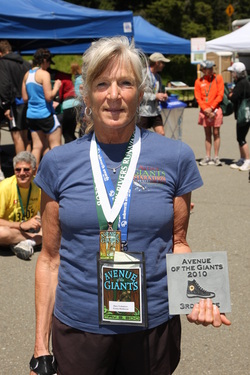
In 2014 at age 53 I ran the Avenue of the Giants marathon in northern California and got smoked by Gina Little of Great Britain, who was 69 or 70 at the time. I had her in sight for maybe 1/2 of the race but then she pulled far, far away. Very impressive!
What can one learn from marathon runners?
Perseverance matters far more than talent or ability.
Training and a healthy lifestyle (good nutrition, sleep, etc.) absolutely pay off very well—but very slowly, more over seasons and years than days and weeks.
Feeling lousy (e.g., at various points in a race) doesn’t last forever.
You can’t control everything (e.g., weather on race day, an oddball injury, etc.)
Everyone is different: take all advice with a grain of salt
Setting goals helps greatly in organizing and motivating your life.
Is it safe to run at nighttime?
That depends entirely on where you run! I run at night lots.
Positives: No need for sunscreen or hat, cooler ( = less water), vastly less traffic
Negatives: Fewer bathrooms open. Need to be a bit more aware of surroundings, and common-sense about where to run. Not as visible to cars. Uneven pavement a bit harder to see. And critters come out at night.
I should add: DO NOT run with headphones at night! That’s just foolish. Truthfully, even daytime headphones are not safe.
How long did it take you to go from hating running to loving it?
For me: a couple of years.
I ran very casually most of my life (like 20 min 3x/week from college to middle age) but never really enjoyed it. (I never hated it though.)
At age 49 I decided to try running a marathon. Trained 20 weeks, worked through injuries, figured out shoes, etc. Very much enjoyed that marathon, especially because I had no particular time goal. I just wanted to finish, and did.
Kept going and now (7 years later) have finished 13 fulls and bunch of halfs.
What happened after a couple of years:
- I was in good enough shape and was experienced enough as a runner to plan and accomplish my training runs and races with a sense of skill and purpose.
- I had learned that the first 2 or 3 miles—which is all I used to run—are really NEVER that enjoyable! The body is just getting warmed up. You just get started knowing you will feel much better AFTER that first 20–30 min.
If I had joined a running club things wd prob have been much different—I wd have learned more, faster.
Everyone is different, physically and psychologically. I don’t think everyone could or should love running. But I’d say you have to work at it a year or two before you’ve given it a fair try.
What running strategy would you advice for someone aiming at a 3:00 marathon time for The San Francisco Marathon?
A 3:00 marathon anywhere, even a completely flat course, is a hard core, very ambitious time for an amateur runner. By the time you have done the kind of dedicated, multi-year training, diet adaptations, injury recovery, and general lifestyle changes needed to seriously contemplate a 3:00 finish you will have done lots of reading, learned tons just from 1,000s of miles of training, and spent time with enough other dedicated runners to know what you have to do. The best start is to find a local running club to join and start training with them.
What shall I do in the last few days before running a marathon to prepare myself?
At that point nothing you do will add to your physical strength or stamina. Indeed, you should have a 2-week or so taper well executed, so the last few days are for mental & logistical prep.
Figure out exactly what you will wear and what on-course nutrition you will bring. (Find out from past reviews of your race how reliable the provided gu etc. is. One marathon I ran had nothing after mile 15. I was counting on course gu, so I completely hit the wall.)
Watch the weather closely. Go to the race expo and enjoy it. Be as well-rested and relaxed as possible.
Make a race plan based on your actual fitness and the course profile (elevation, etc.). Be especially definite about pace for the first 4 – 5 miles and convince yourself to hit those times no matter how good you feel (the overwhelming temptation is to go out too fast).
Decide on your time goals for “crazy great,” “happy,” and “o.k.” finishes. Practice using your GPS watch if you have one.
Stay positive, grateful, and excited about the opportunity to do something so fantastic!
I want to run a marathon on each continent. What’s the best combination?
If you run the Istanbul the route crosses over the Bosphorus and you can cross off Europe and Asia in one race! Seriously!
How can I prepare for a 26 mile marathon in 6 months from scratch as a beginner runner?
Six months is plenty of time (assuming you’re otherwise healthy). Find a “couch to finish” or “first time” or “just finish” training plan and just follow it. Mostly it’s just a lot of time, so be prepared for that. You’ll have setbacks (e.g., need different shoes, or get a minor injury) and will have to work through those. Go for it!
How do I get started with running?
Find a local race (5K / 10K / Half Marathon) three or four months out and sign up for it. Tell your friends and fam you’ve done so. Find a training plan and/or training group and start running at least 3 – 4 times a week. Don’t give up when you encounter setbacks (need a different shoe, or get injured, or just get discouraged). Read running articles & books (though taking everything with a grain of salt). Look at other runners and notice that they come in ALL different shapes and sizes, including yours!
How long before a marathon do you start training?
It all depends on your current fitness level and your marathon goal. You can find “couch to finish” plans online that are generally 12 to 20 weeks long. For a first marathon, besides just training miles, you’ll probably have to experiment with shoes, deal with an injury or two, learn about race nutrition and hydration, etc. It’s a big time commitment and some $ too (shoes and gear, a decent GPS watch, race fee, etc. = $500+).
How do you motivate yourself to start running again after a long period of running inactivity?
Sign up for a race and tell all your friend you did so!
How should one prepare for a marathon?
The first, best, and most essential advice I can give you is: make sure you have enough time in your life to train! Like 4 – 8 hours a week. It’s just a lot of time out there running and there are no shortcuts for this.
Also, are there good running places near you that you enjoy enough that you will be motivated to spend that kind of time out there?
There are plenty of online training plans, e.g., this one: How to train for a marathon or half marathon . For a “couch to finish” approach, plan on around 16 weeks of training. Yes, that is a lot of time. Yes, this means running at least every other day and probably more. You mix up different kinds of runs but always include a “long run” at least once a week. The usual advice is that if you can finish a 20 mile long run by 2 weeks before the race you’ll be in good shape for your first marathon. (The last 2 weeks or so are the “taper” when you reduce your miles lots to get fresh for race day.)
Of course you’ll need to figure out shoes that work for you (ignore 90% of the hype and just find shoes that fit well and are comfy), learn how to get fluids and carbs while running, work out your clothes / hat / sunglasses / sunscreen.
If you pay attention to good form early on and maybe even get a bit of coaching that will help for sure. If you get injuries (kneecap pain, side of knee pain) read up on common running injuries and find out what to do—don’t give up, these are all very common.
I’ve run 10 full marathons now (my first at age 49) and for sure the first “I just want to go the distance” one was, in many ways, the most enjoyable. For that first one I put in about 425 miles of training, basically running every other day for about 4 1/2 months.
 Russell Yee