Gone but Not Forgotten: Lost Landmarks in the OMCA Neighborhood
by Russell Yee (OMCA Docent News, 2019)
The Museum’s built environment includes the Alameda County Courthouse (1936), the Henry J. Kaiser Convention Center (formerly the Oakland Auditorium, 1915), and Laney College (1970). Other nearby landmarks have come and gone. Here are some of them.
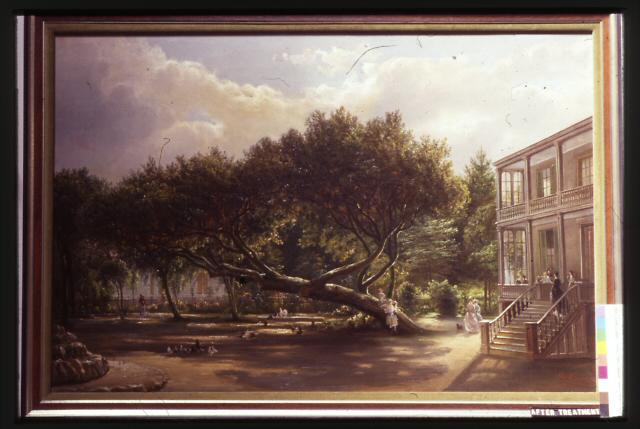
Ferdinand Richardt, “Mrs. Poston’s Female Academy,“ c. 1879, oil on canvas, gift of Miss Elaine Sweet, OMCA collection
Mrs. E.C. Poston’s Seminary for Young Ladies (1873-80)
In 1873, Mrs. E. C. Poston moved her girls’ seminary from Marysville to the former home of General R. W. Heath at Oak St. x 11th, on what is now the OMCA site..(Heath had fought in the Mexican American War and then served as quartermaster for the Pacific Division; he spent his final years at his vineyard in Oakville.) In time up to 75 students were enrolled, assured that “Every pupil was under the direct control and influence of the principal. They form no acquaintance except with her approbation, and mingle in society only under her supervision.” Later, a series of other educational institutions occupied the site through at least the 1890s, including a technical school and a military academy.
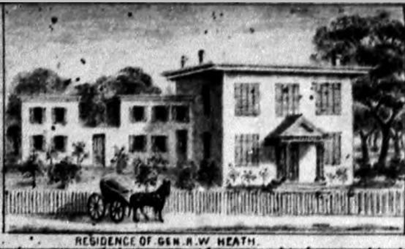
Possibly the first structure on the OMCA site: residence of General R. W. Heath, at Oak St. x 11th (detail from 1860 map of Oakland, Oakland Public Library History Room)
* * *
The Merritt Estate (c. 1860s – ?)

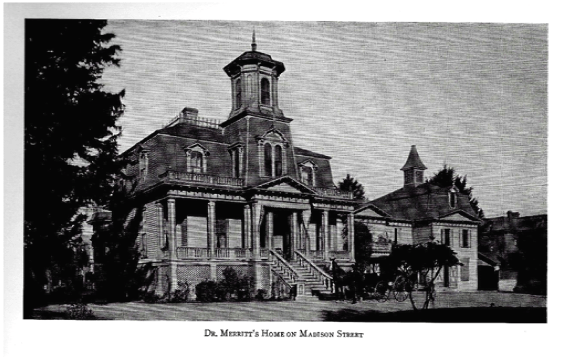
The present spiral Alcopark garage site was the home of Dr. Samuel B. Merritt, Oakland’s 13th mayor, Regent of the University of California, cofounder of Mountain View Cemetery, benefactor of Samuel Merritt Hospital and University, prime mover in the 1869 construction of the 12th St. Dam (now underneath the Lake Merritt Amphitheater), and the leader in the 1870 declaration of Lake Merritt as the nation’s first wildlife sanctuary. Merritt also built numerous other large homes nearby, of which one, the Cameron-Stanford House (1876), still stands. Merritt died in 1890, a lifelong bachelor and without children. His executor was his sister, Mrs. Catherine Garcelon, who had lived with Merritt for some years after the death of her own husband.
* * *
Rosso’s Cottage, Restaurant, and Pleasure Grounds;
Lake View Cottage and Bellevue du Rendez-vous de Chasse
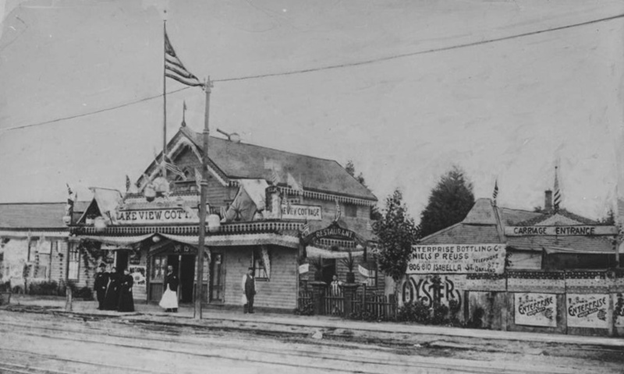
The corner of OMCA closest to Lake Merritt featured this establishment in various configurations and guises. An 1887 ad offered “breakfast and dinner to order; foreign and domestic wines and liquors; private apartments; everything in the best style at reasonable prices; dinner for parties set at short notice.” In 1886, the bartender at Rosso’s shot and killed a patron but avoided arrest because of “sufficient political influence.” For many years the proprietor was one Charles Blaize, who had fled the French Revolution; the restaurant was then known infamously as the “House of Blazes.” The resort as shown sat on pilings over San Antonio Creek on the south edge of the 12th St. Dam. The retouching of the badly mottled original was accomplished by graphic artists at the Oakland Tribune prior to the publication of the image in 1952.
* * *
R. A. Doty Star Cars (1923-68)
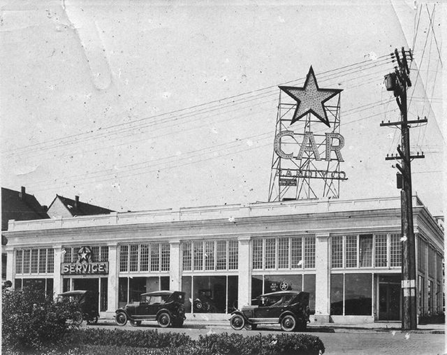
This dealership for the entry-level Star line of Durant automobiles was at Fallon x 12th, now under Tony Labat’s “Big Peace IV” sculpture and where the 11th St. tunnel emerges. Durant Motors ceased operations in 1931. A large billboard replaced the Star signage and remained for many years. The building was demolished for the construction of the Museum.
* * *
First Church of the Nazarene (? – [1949])
This church was originally built as the Swedish Mission Covenant Church, on Fallon between 10th & 11th, so approximately where the Museum’s main ticketing booth and Museum Store are now. In 1940 the First Nazarene Church acquired the building as the Covenant church moved to what is now the Church of All Faiths at Park Blvd x E. 21st; later it would move again to its present site at Lincoln Square on Redwood Road, now as First Covenant Church. In 1949 the Nazarene Church on Fallon was physically moved across the pre-Frickstad 12th St. dam to a new location at 1600 Lakeshore Ave. It was eventually demolished for the 1972 construction of the Rose of Sharon Home. The 1949 move was prompted by city plans for a civic center in the area. The block was cleared and used as a parking lot until Museum construction began.
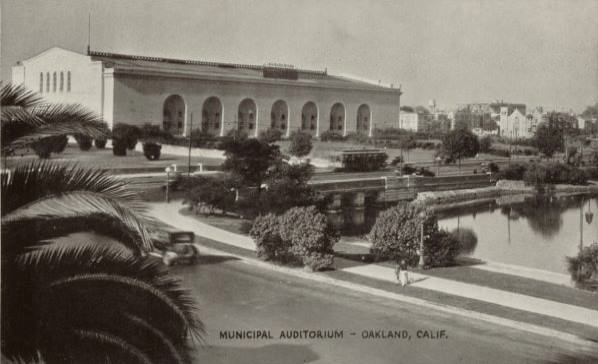
Postcard with Swedish Mission Covenant Church visible in the upper right
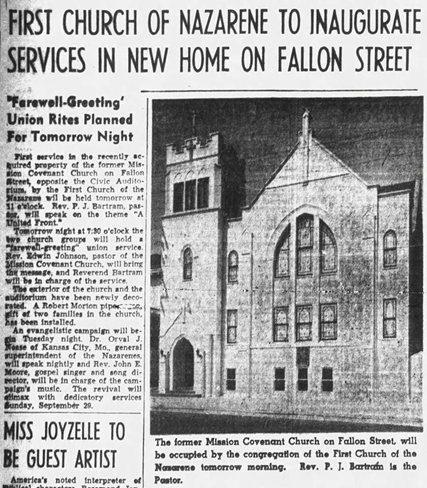
1940 transition from Swedish Mission Covenant to First Church of the Nazarene
* * *
Auditorium Village (c. 1943 – c. 1962)
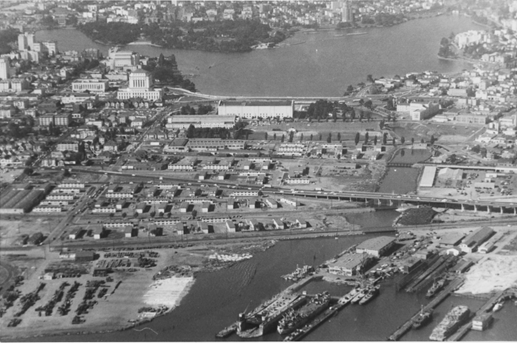
At one time over 400 families lived at this federal wartime housing complex, in dozens of temporary structures on both sides of what is now Interstate 880. The Village even had its own elementary school. The only remaining vestige is Victory Ct. (the street behind East Bay Restaurant Supply).
* * *
Oakland Exposition Building (1931-67)
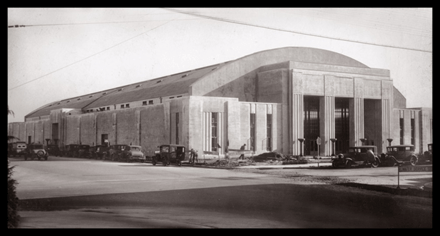
In the area of the Laney College buildings along 10th St. closest to the Museum was a large structure similar to the Cow Palace. It hosted events such as the annual California Garden Show, equestrian exhibitions, and indoor midget car races. It was torn down for the construction of Laney College.

* * *
Peralta Playland (1950-68)
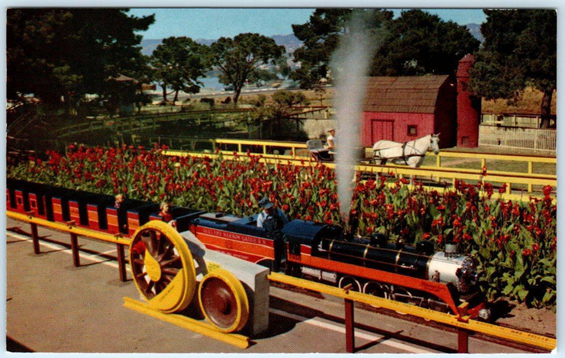
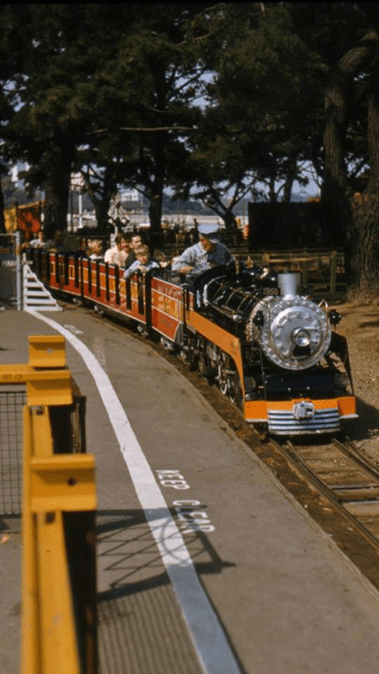
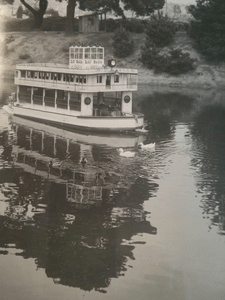
Spanning Lake Merritt Channel to the southeast of the Auditorium was a small amusement park. At various times it featured: the Oakland Acorn narrow-gauge steam railway, the Lil’ Belle paddlewheel boat, a stagecoach, the Star Flyer (an early virtual reality spaceship attraction), and farm animals. The area continues as Peralta Park, with much of the land restored to wetlands and the former fill and culvert over 10th St. daylighted.

* * *
Frickstad Viaduct (1949-2013)
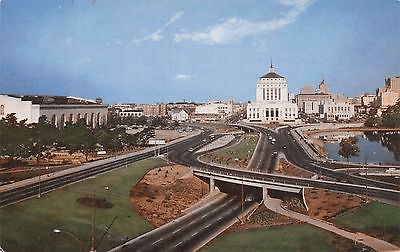
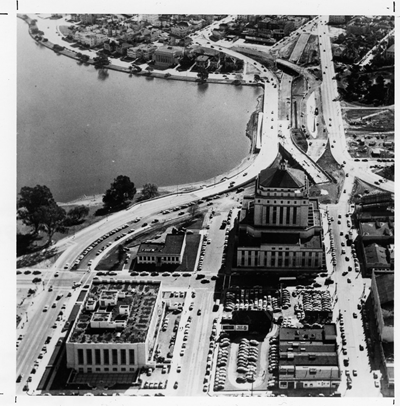
Surely the least-missed landmark is this 12-lane interchange with over- and under-crossings connecting both E. 14th and E. 12th with 12th Ave. and 14th Ave. It was sometimes derided as “the world’s shortest freeway.” To build it, the large gardens in front of the Auditorium were removed and a parking lot installed over the remaining land. The only pedestrian crossings were via foreboding underground passageways. Fittingly, the Viaduct’s first ancestor was a much-resented 1853 toll bridge along 12th St., built by Horace P. Carpentier, Oakland’s first mayor.
* * *
Frank Youell Field (1962-69)
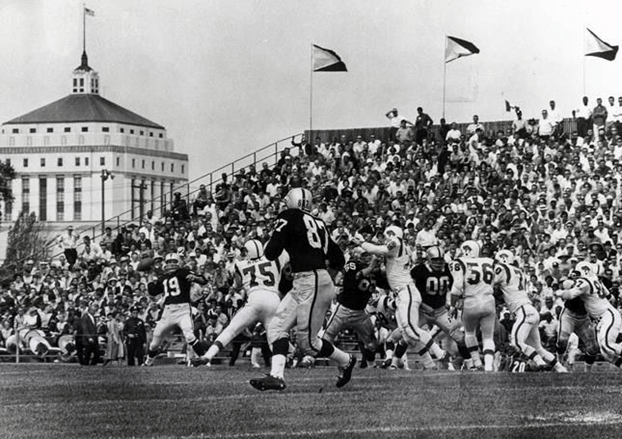
This 20,000-seat stadium was built as the first, temporary home of the Oakland Raiders, who played there 1962-67 while the Coliseum was being built. It stood where the Laney College main parking lot along 880 is now, and was demolished in 1969. Youell (1883–1967), an local undertaker, mortuary owner, Oakland Councilman, and sports booster.
* * *
Japantown
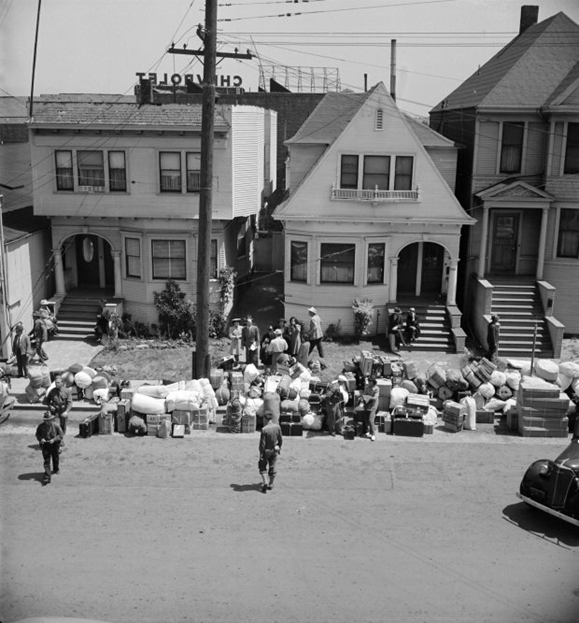
Oakland’s prewar Japanese community of some 1,800 residents and several hundred professional offices, storefronts, restaurants, churches, schools, temples, associations, and businesses was notably spread throughout many neighborhoods. However there was a substantial presence intermingled with Chinatown, especially in the Madison Square neighborhood, adjacent to the Museum. At the time of the infamous Executive Order 9066, Oakland’s Japanese residents reported to the Civil Control Station at 1117 Oak St., now the Alameda County Law Library, across Oak St. from the Museum. Among Dorothea Lange’s internment images is this May 1942 picture of families preparing to be removed. These three houses were on Oak St. where the Museum parking entrance is today. (Note the “CHEVROLET” billboard above the former R.A. Doty dealership).
* * *
Unbuilt, Proposed, and Planned Landmarks
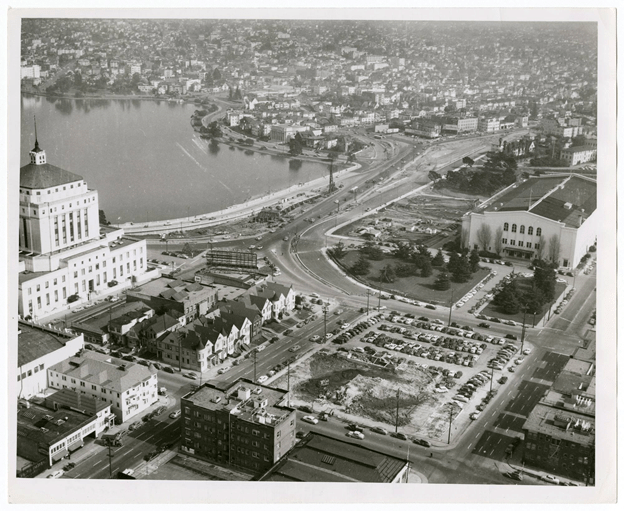
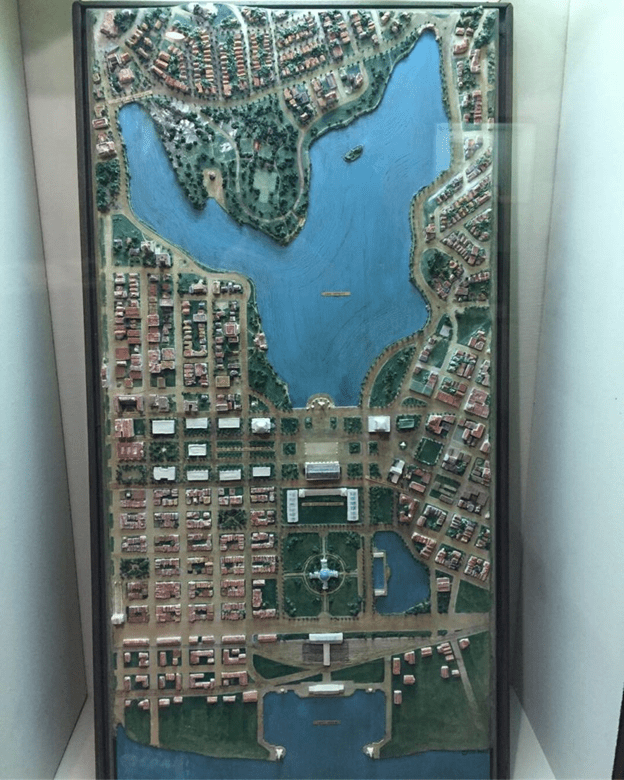
A 1947 Civic Center plan imagined a complex of government buildings, an opera house and symphony hall, a sports arena, and a large civic plaza in the Museum neighborhood. While Alameda County offices and the Museum itself came to fruition, City, State, and Federal buildings eventually clustered downtown around City Hall.
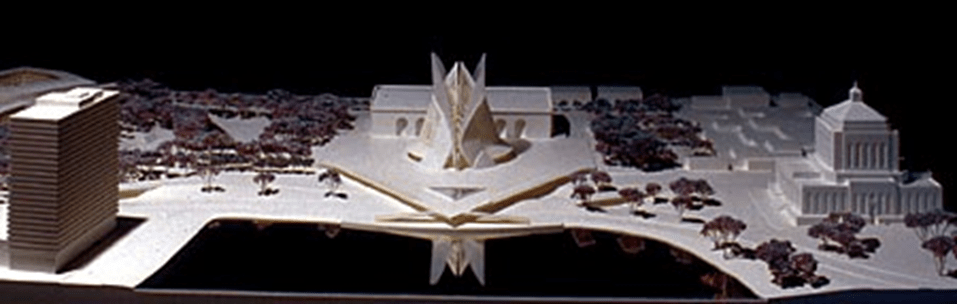
In 2001 the Diocese of Oakland met heavy opposition to a proposed replacement cathedral directly in front of the Auditorium and designed by Santiago Calatrava; it instead built the Craig Hartman-designed Cathedral of Christ the Light (2008) adjacent to Kaiser Center.
By 2005 the Auditorium had become financially unsustainable and was closed. The next year, voters rejected a proposal to convert it to a relocated Main Library. In 2015, Creative Development Partners proposed One Lake Merritt, a renovation of the Auditorium and the construction of an adjacent 280-room hotel. Presently the Orton Development group is pursuing its plan for renovating the Auditorium as the Oakland Civic: a combination of commercial office space and a community arts and performance venue. Meanwhile, one of the city’s temporary Tuff Shed communities was installed on the southeast side.
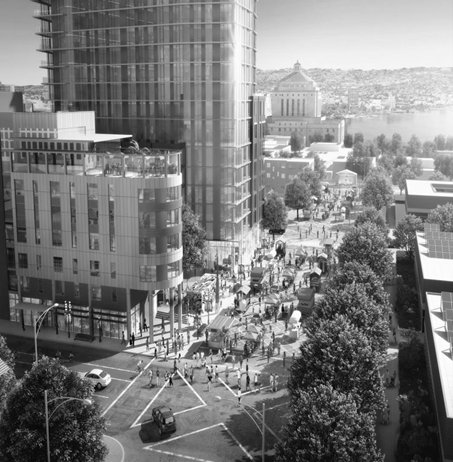
In 2014 the city adopted the Lake Merritt Station Area Plan. In 2018, as part of that Plan, BART began work with the East Bay Asian Local Development Corporation (EBALDC) and Strada Investment Group to develop a large-scale multi-use high rise project above the station. Those two blocks (8th to 9th, from Madison to Fallon) are planned to include 519 units of housing (44% affordable) and 517,000 square feet of office and retail space.
 Russell Yee