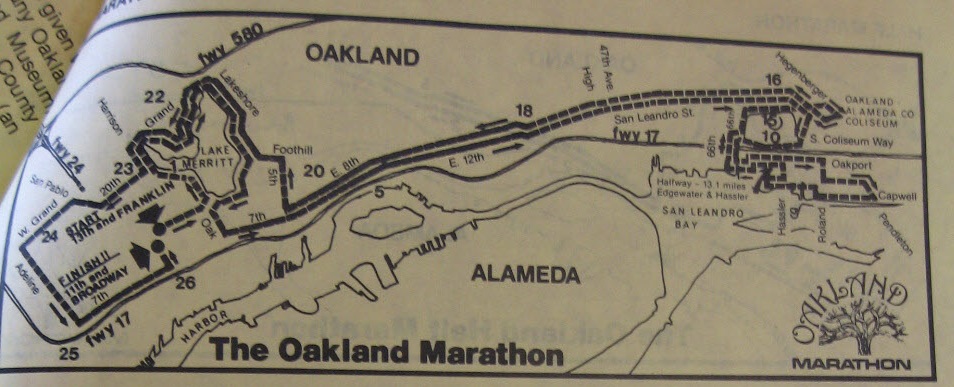
The Original Oakland Marathon was run 1979-84, except not 1982. Here are some retrospective news stories:
Oakland Marathon returning after 25 year hiatus
Oakland Marathon returning after 25 year hiatus
Paige A. Ricks on October 29, 2009
Oakland North
It has been 25 years, but it’s coming back.
San Francisco has one. San Jose has one. Sacramento has one. And when Gene Brtalik, who happens to work for an extreme sports event planning company, moved to Concord last January, he saw both a void and an opportunity. “Oakland is the only major city in the Bay Area that currently doesn’t do marathons,” he says.
Brtalik works for Corrigan Sports, which is based in Maryland and is now the official organizer of the 2010 Oakland Marathon–the city’s first marathon in a quarter century.
Since his idea in January, he has been busy. It took four months for the city of Oakland to approve the event proposal, and then with the help of Oakland’s running community, Brtalik created the running courses and is now pulling together sponsors.
The 26.2-mile marathon, one of several races scheduled for March 27 and 28 in a weekend event called the Oakland Running Festival, follows a course that begins on Broadway outside City Hall. It winds through North Oakland for a while, eventually heading out Moraga Avenue to Lincoln, down to East, and then back around Lake Merritt before ending up again at City Hall.
“We want to show off the entire city,” Brtalik said. “Some areas are hilly, but that’s a part of Oakland.”
But the course is a little different than it was 25 years ago. There was only one peak of elevation in the course then, the Hegenberger freeway overpass, crossing over Alameda to San Leandro Bay. Runners ran through a maze of left and right turns near the Oakland Coliseum before returning the other direction on the overpass. They then followed half of the perimeter of Lake Merritt on Lakeshore and Grand Avenue, past 20th Street, down Adeline and finishing on 11th Street and Broadway.
Michael Pinocci, 54, of Las Vegas, ran the marathon course in 1982.
“I can still visualize the finish,” he said. He said he could remember his mother and father on the sideline, cheering him on as he ran an uphill grade to the finish line. He and a Canadian runner were neck and neck. Obviously, he was trying to win. He finished second, missing first place by 35 seconds, but his second-place finish qualified him to run the marathon in Fukuoka, Japan shortly afterward. Pinocci, who grew up in Fremont, said he remembered the weather was beautiful in Oakland the day he ran. “I remember I ran my personal best,” he said. “ It will always be at the top of my list.”
Len Goldman, president of the Lake Merritt Joggers and Striders Running Club, said he remembers reading about the marathon 25 years ago and its successful turnout. The Joggers and Striders club is the oldest and largest running club in the East Bay, with 250 members. Goldman estimated that 50 of them plan to run the marathon.
Goldman, who is originally from Indiana, has lived in Oakland since 1968 and said he partnered with Brtalik, as well as the East Bay Front Runners and Walkers, to design the course. The goal: to show off the city. He said most marathon courses are “more forgiving,” with less elevation, but that Oakland is unique.
Goldman is 65, and said he has been training to run the half-marathon. He runs at least 35 miles a week to reach his goal of running it in 90 minutes. “I find it therapeutic,” he said. “I forget about everything, and enjoy being outside and running.”
He said he hopes the returning marathon will bring positive news to the city and attract people from all over the Bay Area. “People have the image of Oakland as gangs and sideshows, but the marathon will show a side of Oakland that doesn’t make the headlines,” he said.
Kei Kodani, manager of the College Avenue running and swimming apparel store Transports, agrees that the Oakland Running Festival, which is currently only sponsored by Geico, will bring positive attention to the city as well as to the running community. “It’ll bring the focus to Oakland as a running city,” he said. “A place for runners.” The event might also bring prestige, he said, if elite runners perform. He said is undecided about whether he will participate. “There are some parts of the course that have me uncertain,” he said. There is a steep downhill run on Lincoln Avenue which Kodani said, “Would be nearly impossible.” He said the hill is very difficult to just walk and after running many miles before, running downhill can be more difficult than running uphill.
But Kodani said he may run the half-marathon — he has some time to think. Participate registration begins Nov. 1 and continues up until the event day.
Brtalik said the Oakland Running Festival is doing things a little differently by also offering four-person relays and children’s races. “Not everybody can do a marathon,” he said. “Not everybody can do a half-marathon.”
He said the main purpose of the event is to bring out the community, but that it’s also a good marketing move for the city of Oakland. Brtalik has set a turnout goal of 7,000-8,000 participants across all five races — the marathon, half-marathon, four-person relay, 5K and kids’ fun run. There will be awards given for each age group of each race and cash prizes for winners of the marathon race. “When mom and dad go home with a medal, they can be like mom and dad and go home with a medal too,” Brtalik said.
Pinocci, who has run 40 marathons–18 with a time under 2:20, which makes him a very speedy distance runner–said he believes the event will draw many first-time marathon runners. “Its amazing what the human body can do,” he said. “Some people have goals to break. Everyone has a goal and it may be just to finish.”
Can Oakland Go the Distance?
Can Oakland Go the Distance?
After a 25-year hiatus, the Oakland Marathon returns next week with an eye-popping new route and a menu of race choices.
Gene Brtalik, whose employer promotes and organizes the Baltimore Marathon, saw that Oakland had a gap begging to be filled. Credits: Joseph Schell

By Dan Schoenholz
East Bay Express, Mar 17, 2010
On a cool, crystal-clear November morning, the weather is perfect for a run. Outside of Lululemon, a chic athletic apparel shop at the corner of Ashby and College avenues in Berkeley, a crowd starts to assemble on the sidewalk. It’s a colorful spectacle — an ethnically diverse gathering of about 100 runners sporting bright race T-shirts, neon shorts, and shiny white shoes that look like they’ve yet to step in a puddle.
The occasion is the inaugural group training run for the Oakland Running Festival, which is scheduled for the weekend of March 26-28 and will include the first road marathon to be held in Oakland in more than 25 years. Len Goldman, the sprightly 65-year-old president of the Lake Merritt Joggers and Striders running club, shouts above the drone of traffic. He welcomes everyone and explains that over the next four months, the group will run together each Saturday morning, gradually increasing the mileage until participants are fully prepared for either the 26.2-mile marathon or the accompanying half marathon. The day’s run will be an “easy,” five- or six-mile jaunt past the east side of the UC Berkeley campus to Codornices Park, then down the hill to Oxford Street before returning to the store for post-workout refreshments — and possible purchases of tony running wear.
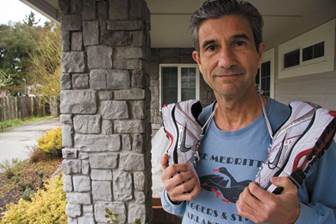
Jack Zakarian ran in the 1981 Oakland Marathon and plans to run again this year. Credits: Joseph Schell
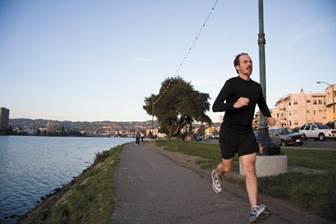
Matthew Riutta decided he wanted to run a marathon before he turned forty. Credits: Joseph Schell
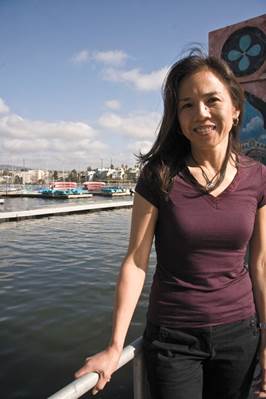
Barbara Jung plans to run the half-marathon. Credits: Joseph Schell
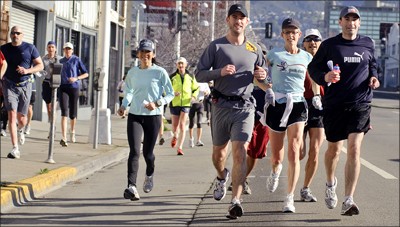
There is an upbeat vibe among the runners. It’s a beautiful day, their legs feel fresh, and the race is still four months away. The atmosphere feels like the first day of school.
Longtime Oakland runners and the race organizers are optimistic, too. They see the Oakland Running Festival as an opportunity to promote both Oakland and running, and as a way to unify a community that is often divided by racial, economic, and geographic differences. Marathons are big events in many cities — New York and Boston, famously, but also Baltimore, Cincinnati, Houston, and countless others — and serve as a source of civic pride and unity. Why not Oakland?
It turns out that local business people and politicians had the same notion in the early Eighties, when, for three or four years, the Oakland Marathon was a destination race for runners in California and beyond. But instead of evolving into the Boston Marathon of the West, as boosters hoped, the Oakland Marathon vanished abruptly, leaving a void that marathons in San Francisco, Sacramento, and San Jose have only partially filled.
The question for skeptics in Nikes, then, is why will things be any different in the new millennium? What reason is there to believe that Oakland can support a big-time marathon for the long haul this time around?
One person who is unabashedly bullish on the Oakland Running Festival’s prospects is race director Gene Brtalik, the man who came up with the idea. Brtalik works in marketing for Corrigan Sports, the Maryland-based promoter and organizer of the Baltimore Marathon. When his wife got a job in Oakland and the couple relocated from the East Coast in October, 2008, Brtalik looked into the local race schedule. He learned that Oakland had no marathon, and saw a gap begging to be filled.
After receiving the go-ahead from his boss, Brtalik e-mailed the Oakland City Council to propose a race weekend and offer Corrigan Sports’ promotional services. Within three hours, he received responses from several councilmembers. After a few months of ironing out the details with city staff, the council approved a resolution in support of the event last June.
Brtalik sees no reason why the Oakland Running Festival can’t be as successful as his company’s flagship running weekend in Baltimore. According to Brtalik, the Baltimore event started small but now has 20,000 runners annually and has become a huge community happening, with about one of every four people in the city participating in some way.
Brtalik credits the event’s success to the way it’s organized. “There are five races so most people can find something they can participate in,” he said. In addition to the marathon and half-marathon, the Baltimore festival includes a 5K, a kids’ fun run, and a four-person relay. “We make it walker-friendly for those who don’t run,” he added. “We make it family-friendly. And there’s also a party atmosphere afterward. Now it has become the thing to do. One person does it and has a great time; the next year their friends want to do it.”
The Oakland Running Festival is based on the same model, and Brtalik expects it to follow a similar growth trajectory. “We’re looking for 7,000 to 8,000 runners across five events this year,” he said. “We want to start small and make sure we can handle the crowds. In Baltimore the size has increased 10 to 15 percent each year, and that’s what we’re shooting for in Oakland.”
Brtalik also has high hopes for the competitive aspects of the race, and in future years, hopes to offer purses to attract elite runners like the Boston and New York marathons. “The other local marathons don’t have big purses, so that could be something that would set us apart,” he said. “The big names in marathoning like Ryan Hall run the big races, but we get the next level in Baltimore. That’s the vision for Oakland in the short term. But who knows? Maybe in the long term our purse will get to the same level as Boston.”
More than thirty years ago, local boosters expressed similar visions for Oakland as a premiere event on the national running scene. A special race-day insert on December 2, 1979 in the Eastbay Today, a now-defunct version of the Oakland Tribune, noted that “the first-ever Oakland Marathon has attracted national recognition as a race with the potential to become the Boston Marathon of the West.”
At the time, running was booming. Frank Shorter’s victory in the Olympic Marathon in 1972, the publication of Jim Fixx’s bestseller The Complete Book of Running, and increasing interest on the part of Baby Boomers in health and fitness all contributed to an explosion in the sport’s popularity.
Initially, the Oakland race was successful in capitalizing on the burgeoning participation in road racing. In 1979, a total of about 2,000 runners toed the starting line for the inaugural marathon and half-marathon. By 1981, the number had skyrocketed to 6,000 and Eastbay Today was noting that the race would “reach five figures by 1983 if it continues to grow at its present rate.”
One of those in the half-marathon field in 1981 was Jack Zakarian, a founding member of the Lake Merritt Joggers and Striders. Now 57 years old, Zakarian will be running the full marathon on March 28. “I want to see a big race come back to Oakland. We’ve had a couple of previous attempts but they didn’t last,” he said, referring to the previous iteration of the marathon and a race called the Oakland Double 10K. “We’ll see if Oakland can make it work this time.”
Although he doesn’t remember a lot of details about the 1981 race, which featured a flat course between downtown and the Coliseum area, Zakarian does recall that it was a different kind of route for him. “I usually ran more in the country,” he said. “I remember going down East 14th Street and thinking, ‘What am I doing here?’”
Zakarian notes that the world of running is a lot different than it was thirty years ago. “In the early days, there were recreational runners, but most people were fairly serious about running as a sport,” he explained. “Today, a lot of people are running to raise money or for personal growth. I think that’s great, but it’s definitely different. There’s also a lot more knowledge about training and nutrition now. Sports drinks and energy bars weren’t very available — Powerbars, electrolyte replacements — we didn’t have any of that. When I ran cross-country in college, we had steak and eggs for breakfast on the day of the race. That would be ridiculous now.”
A chemical engineer with Chevron, Zakarian will run Oakland despite suffering from tachycardia, a heart condition that he says prevents him from exercising excessively. (Apparently, Zakarian has convinced his doctor that a 26.2-mile race with nine miles of uphill does not qualify as excessive.) Zakarian wears a heart monitor to ensure that he doesn’t overdo it, and like a true old-school runner, he’s not worried about a possible heart attack, but sounds annoyed that his condition affects his race times.
Matthew Riutta, a 39-year-old Oakland-based film and television location manager and producer whose credits include Milk and Rent, is more representative of the new school of runners.
“I mainly decided to run a marathon because I’m turning forty this year,” he said while jogging down Hearst Avenue in Berkeley. “I think it’s just one of those rites of passage I have stuck in my head — probably due to Oprah running her marathon at forty. I have a laundry list of things I wanted to do before I was forty and this is one of them.”
Riutta ran cross-country as a high-schooler in Indiana and has completed 10K races and San Francisco’s Bay to Breakers, but nothing remotely close to the marathon distance. While he sees the marathon as a personal challenge, he also appreciates the benefits of running with others. He says he “wanted to be around some folks who are newbies, like me, but also be around pros. Plus, I think it will be a wonderful thing to experience the feeling of completing a challenge as an individual, but also supported as a group.”
And once he decided to run a marathon, why did he choose Oakland? “I just thought for my first marathon I’m gonna do it in Oakland — because it’s my current hometown, it being the first one in twenty or so years, and I saw the course online and thought, ‘Wow. This is gonna be beautiful to witness because Oakland is such a dynamic town,’” he said.
Another big change since the days of the first Oakland Marathon is the number of women hitting the roads. According to Running USA, a national organization that analyzes running trends, women now make up about half of all race participants, compared to just 21 percent in the mid-1980s.
This statistic jibes with the Oakland Running Festival training group, which appears to consist of about equal numbers of men and women. One of the women is Barbara Jung, a 45-year-old mother of two and OB-GYN at Kaiser Permanente in Oakland. She’s an experienced long-distance runner, with six marathons and four half marathons on her running résumé. She’s also fast enough to have qualified to run the Boston Marathon, giving her bragging rights in the world of marathon racing.
But Jung doesn’t need to run another marathon to prove anything. She admits that she now runs mostly because she’s “a little addicted” to it. “It’s therapeutic for me,” she said. “A perfect mental break.”
Shirley Douglas, on the other hand, says she is only running the race because it’s in her hometown. “It’s a good opportunity to celebrate Oakland,” she said. “The course actually goes through the back of my neighborhood.” The 61-year-old retired marketing consultant is philosophical about how her running is progressing. “It’s like golf,” she said with a smile. “Sometimes it goes well, and sometimes it doesn’t.”
If you look under “Sports — Racing” in the archives of printed materials in the Oakland History Room at the Oakland Public Library, you’ll find a manila folder that contains newspaper clippings and programs covering a century of racing in the East Bay. Among these historical goodies — ample material for a former marathoner to pass a pleasant, nostalgic afternoon — are documents about the Oakland Marathon’s genesis and early successes, but not a hint as to the reason the popular race shut down after a few years.
A possible explanation was that the popularity of running in general abated after the boom of the 1970s, and there was a corresponding decrease in financial support from race sponsors. Another intriguing explanation was given by longtime local runner Mike Frankfurt, who attributed the end of the marathon to alleged embezzlement on the part of the race promoter.
Whatever the reason for the failure, Oakland has reason to be cautiously optimistic that this iteration of the marathon will show more staying power.
First, we are in the midst of a second running explosion that makes the one in the 1970s seem more like a firecracker. Participation in road racing is at unprecedented levels. According to Running USA, nearly nine million people participated in races in 2007, more than double the number twenty years earlier. A separate study by Race Results Weekly found that participation in 2009 grew by 11 percent over the previous year.
Many of these new runners are interested either in raising funds for worthy causes or in self-actualization. The East Bay, with its legions of socially conscious and self-improving residents, could find that the Oakland Running Festival not only serves their interests but does so in their backyard.
A second factor that might help this race succeed where its predecessor failed is the race course itself. While the original Oakland Marathon course was flat and fast, it wasn’t particularly scenic. Even though it incorporated Lake Merritt and downtown, much of the race took runners through nondescript industrial areas near the Coliseum — hardly the stuff of race posters.
The 2010 version, by contrast, starts at City Hall, winds its way up through Montclair, passes by Joaquin Miller Park, and heads back toward downtown. After passing Jack London Square and circling Lake Merritt, the race ends at City Hall. “Oakland gets kind of a bad rap,” said race director Brtalik. “My whole thought in designing the course was to make it scenic. I want people to see what it has to offer.”
Brtalik consulted with local runners, including Goldman of the Lake Merritt Joggers and Striders and Richie Boulet, who owns Transports running store on College Avenue in Oakland’s Rockridge district and is married to local-distance running Olympian Magdalena Boulet. Based on the input he received, Brtalik decided to include a climb up into the hills to the corner of Mountain Boulevard and Lincoln Avenue, near the Mormon Temple. “That corner is probably one of the best views I’ve ever seen on a course, and I’ve run a lot of them,” he said. “It will be a challenge to get up there, but there aren’t too many places with a view like that.”
A final factor, perhaps the most important determinant of the race’s success, is how well it’s organized. Urban marathons are big, complex events requiring committed sponsors, effective marketing, legions of volunteers, cooperation from the city government around street closures and security, and grassroots support from the community. Corrigan Sports took the Baltimore Marathon and gradually grew it into the popular celebration it is today. If the company shows the same patience and stewardship here, the prospects for a 2020 Oakland Running Festival appear to be good.
Brtalik said earlier this month that the Oakland Running Festival had already attracted more than 5,000 entrants, more than twice as many as the first Oakland marathon and half-marathon in 1981.
On a late February morning, the once buoyant mood of the Lake Merritt Joggers and Striders training group is more subdued. If the November outing was like the first day of school, this day is more like a review session before a particularly formidable final exam. As the group congregates for a twenty-mile jaunt, the weather is gloomier, the conversation between runners less animated, even the running shoes are noticeably less bright.
A lot can happen during the months of preparing for a marathon. Motivation can flag, work and family pressures can take precedence, and as the miles mount, so can the injuries. According to club president Goldman, the training group has shrunk to about 60 percent of its original size. Among the casualties was Barbara Jung, the veteran marathoner with nothing left to prove. She hurt her calf and had to stop running for five to six weeks. Although she still intends to complete the half-marathon, she has abandoned any hope of running the full distance.
While Goldman gives final directions to the training group, a latecomer trots over to join in. It’s Matthew Riutta, the 39-year-old who’s determined to run a marathon before he turns forty. He’s had an ankle injury, but found a great physical therapist and still plans to run the race.
Riutta’s determination hasn’t wavered. Persistence and a little luck — those are the ingredients for success in a lot of realms, including long-distance running. If Riutta, his fellow runners, and the race organizers remember that, they — and the Oakland Running Festival — should be fine. As the saying goes, it’s a marathon, not a sprint.
Before the Oakland Running Festival there was the Oakland Marathon
By Angela Woodall | Bay Area News Group, Oakland Tribune, Mercury News
PUBLISHED: March 17, 2014 at 10:09 AM PDT
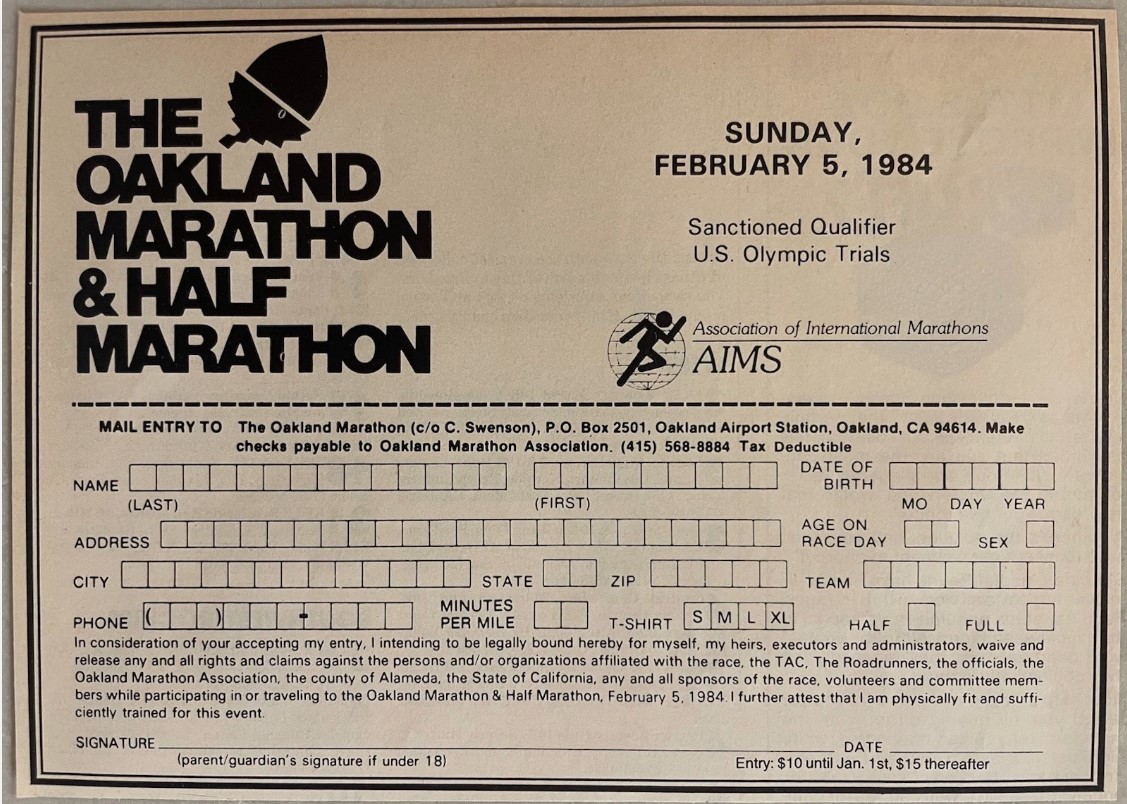
OAKLAND — In the early hours of a gray, cold December morning in 1979, thousands of runners heard the blast of cannon and swarmed on to 13th Street, marking the first Oakland Marathon — 35 years ago. Some of the 2,000 runners chased Olympic dreams. Others were there just to prove they could master 26 miles and 385 yards, a distance that no man or woman has run in less than two hours.
The Oakland Marathon would last only five years, disintegrating in a cloud of disappointment then scandal. Nearly three decades passed before an extreme sports enthusiast, Gene Brtalik, convinced his boss at Corrigan Sports Enterprises to revive the tradition in 2011 with the Oakland Running Festival. Sunday will mark the fifth anniversary. At least 6,500 people have signed up.
“Hopefully, this one will make it to six,” said Joe Schieffer, who ran in the Oakland Marathon and the Oakland Running Festival. Schieffer’s best time in the original race was 2 hours and 27 minutes. “Let’s put it this way: that’s at the front,” the real estate attorney said. But it was seven minutes slower than 1979’s winner and marathon organizer, Ted Quintana. “That shows you how many good runners there were,” Schieffer said.
He has 99 ultramarathons under his belt and in 2007 logged 100,000 miles — slightly more than the distance around the earth multiplied by four. “Now I’m up to 117,000,” said Schieffer, now a lean 64 year-old. “I’m doing this on muscle memory,” said Schieffer, who carries 130 pounds on his 5-foot-11 frame.
The Oakland Marathon course took Schieffer and his fellow runners from downtown around the Oakland Coliseum into West Oakland and back.
It was “flat and fast,” said Dick Hughes, a runner who meticulously measured the course.
The police said Oakland, measuring only 5-by-10 miles, was too small, and some runners flat out told organizers Oakland was too dangerous.
Oakland City Council members suggested the runners circle Lake Merritt until they got to 26.2 miles if they wanted a marathon. The other option was to run from downtown to the Coliseum and back. “That was boring as all get out,” said Hughes, now 80.
The race grew bigger than anyone expected, he said.
“It was a blast.”
Then, as now, the event attracted a variety of athletes. Jay Helgerson, a 24-year-old former Marine, was determined to see his name in the Guinness Book of World Records (changed to Guinness World Records in 2000) as the man who ran a marathon each week for a year. He accomplished this in early 1980. Robert Sallie skated all 26.2 miles in the first Oakland Marathon. “It’s hard man. I couldn’t keep up with the lead runners,” he told reporters afterward.
The next year, 4,000 runners signed up. A’s hitter Rickey Henderson waited at City Hall Plaza to hand out awards.
But the city would have to wait for more than a year for the next Oakland Marathon. Scheduling conflicts with the premier competition of the time, the Fukuoka Marathon in Japan, forced organizers to postpone the race in 1982. Also, the Raiders were playing that weekend in December.
The organizers moved the date to February 1983 when 6,000 runners signed up for the marathon. The race ran into trouble in 1984, finishing $22,654 in the red.
Marathon Chairwoman Cherie Swenson canceled the race in 1985.
“We didn’t have the staff, the money or the support from the city,” said Swenson, who ran a political public relations firm at the time. She could never find a major sponsor for the race.
“We had to pay the police $25,000,” she said last week. “And that just killed it.”
A marathon was planned for 1986. But city officials discovered the new organizer had only $60 in his bank account and $11,000 in bills despite the entry fees sent by runners. He didn’t actually have authorization to accept the fees, but he did anyway, according to press accounts from the time.
Schieffer ran all five years of the original marathon. He has competed twice in the Oakland Running Festival; the marathon in 2011 and the half-marathon in 2012, which he plans to run again Sunday. People now are doing it just to see if they finish, which is OK by him. They should just come out and have fun, he said. Maybe, he added, the person who decides to walk the 5K this year will run it next year.
 Russell Yee


